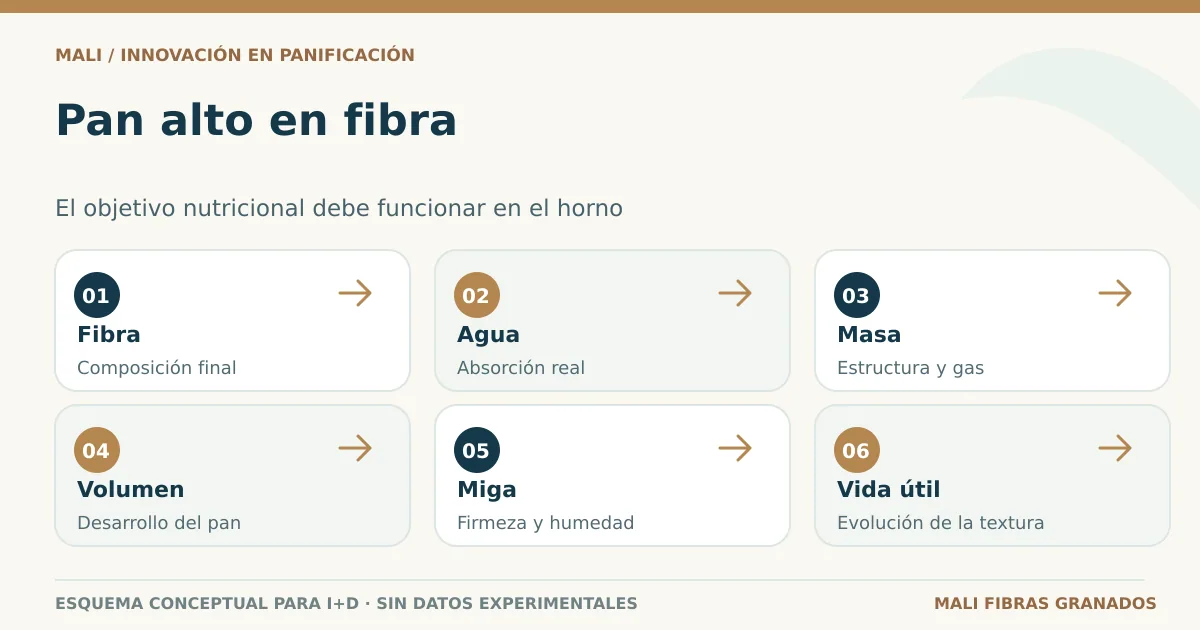
fibre in breads and snacks
High-fibre frozen par-baked bread: formulation, freezing and finishing
Developing a par-baked bread high in fibre requires defining the complete sequence: dough, par-baked, frozen, storage and final baking. The result is valued in the bread that reaches the consumer.
What changes when developing a par-baked bread with fibre
For high-fibre par-baked bread, formulation must fit two baking stages and the intermediate storage system. The aim is the desired composition and eating experience after final baking, not merely easy-to-handle dough or an attractive par-baked piece.
The brief must specify where production stops, how the product is stored and who finishes it. A baguette finished in-store and bread baked in food service may require different instructions and quality criteria.
Frozen par-baked bread and frozen dough: differences
These processes are not equivalent. The Spanish standard defines par-baked bread as dough whose baking is interrupted before completion and which is then preserved by freezing or another authorised method. Frozen dough is frozen without this partial baking and may be shaped or unshaped, fermented or unfermented. [1]
| System | Time of storage | What the project should specify |
|---|---|---|
| Frozen dough | Before baking | Forming and fermentation status; missing operations |
| Frozen par-baked bread | After initial partial baking | Degree of par-baking, storage and finishing conditions |
| Fully baked frozen bread | After complete baking | Thawing and planned serving or reheating |
Calling all "frozen bread" hides differences that matter when choosing ingredients and designing the process. In this guide we focus on par-baked bread that is preserved frozen and then finished baking.
What does research say about fibres and par-baked bread?
A paper published in LWT studied different fibre sources in frozen par-baked bread, including wheat bran, resistant starch and locust bean gum. It compared technological quality with breads made using a conventional process. The results show that ingredient response must be interpreted within the production and storage system. [2]
Another study compared enriched breads made from frozen dough and partially baked pieces. The stage at which the product is frozen is therefore relevant when interpreting ingredient response and final quality. [3]
These references support a process-specific formulation approach. They do not make it possible to claim that a fibre protects any bread equally against freezing, nor to fix a universal dose.
How to choose fibre for a par-baked line
We propose to sort the selection in three levels. First, the composition sought on the finished bread. Then, the sensory profile: colour, taste, texture and presence of particles. Finally, compatibility with the actual operations and conditions of the line.
The guide to choosing bakery fibres compares ingredient families. For par-baked bread, this initial selection must be supplemented with process information: shaping, fermentation, initial baking, frozen storage and final baking.
If psyllium is selected, specify the dosage basis and incorporation method. The guide to psyllium in bakery applications explains those distinctions. When switching between oat bran and oat fibre, check their composition and function.
Water, par-baking and finishing: how to order the review
The water added to the kneading is only part of the product description. To compare formulations, we also recommend recording weights at relevant production moments. The nutritional data per 100 g depends on the final product and its weight, not only on the kilograms of fibre incorporated into the dough.
| Stage | Information to be set | What Helps Check |
|---|---|---|
| Mixing and shaping | Formula, total water, order of incorporation and weight of part | Consistency and handling of the dough |
| Fermentation and par-baking | Line and breakpoint conditions | Condition of the piece before preserving it |
| Cooling and freezing | Sequence, conditions and protection of the product | Consistency between production and conservation |
| Storage and distribution | Expected conditions and duration of the circuit | Quality at the end of the defined period |
| Final baking | Equipment, instructions and final weight | Crumb, crust, colour and composition of the bread as served |
This sheet allows factory and finishing point to work with the same reference product. Avoid valuing a formulation with a final baking different from the one the customer will use.
What to observe after the final baking
Assessment must reflect the intended use. For a baguette, crust and slicing performance may be decisive. For a sandwich roll, bite and strength during service also matter. Set the evaluation time after final baking in advance so comparisons are meaningful.
- Volume and shape: height, expansion and regularity of the pieces.
- Crumb: firmness, elasticity, perceived humidity and compact areas.
- Crust: colour, integrity and texture required for the format.
- Use: cutting, filling, service and evolution during the planned period.
A fibre’s water-retention capacity does not, by itself, demonstrate longer shelf life. The bread storage guide explores that issue; here, the focus is on keeping formulation, freezing and final baking consistent.
When high fibre content can be communicated
The claim requires at least 6 g of fibre per 100 g or 3 g per 100 kcal under European conditions. It must be substantiated for the food ready to eat according to the manufacturer’s instructions. For par-baked bread, final baking and weight loss form part of this check. [4] [5]
For the complete calculation, see how to develop high-fibre bread. The mix data sheet and final bread specification serve different roles within the project.
Frequently asked questions about par-baked bread with fibre
Can a fresh bread recipe be transferred directly to frozen par-baked?
It should be treated as a starting point. The change incorporates preservation and finishing, so you have to review the result in the complete sequence.
Which fibre works best on a par-baked bread?
There is no universal choice. The choice depends on the bread, the composition sought, the sensory profile and the conditions of manufacture and preservation.
Do frozen dough and par-baked bread need the same approach?
No. They are interrupted in different stages. Before selecting the solution, it should be defined which operations are performed before and after freezing.
Does the mix fibre equal the fibre of the finished bread?
No. The mix dose, the rest of the ingredients and the ready-to-eat product should be considered. The percentage of fibre of the isolated ingredient is not transferred to bread.
Plan a development for your par-baked process
To assess a solution, share the product format, freezing system, storage chain and final-baking conditions. With this brief, Mali Fibras Granados can assess a bespoke mix within its fibre solutions for bakery applications.
Sources and references
- BOE. Royal Decree 308/2019: quality standard for bread, consolidated text — Article 7: semi-finished products. Back to text: 1
- Almeida, Chang and Steel. Dietary fibre sources in frozen part-baked bread: Influence on technological quality. LWT (2013) Back to text: 1
- Mandala, Polaki and Yanniotis. Influence of frozen storage on bread enriched with different ingredients. Journal of Food Engineering (2009) Back to text: 1
- European Commission. Conditions for nutrition claims Back to text: 1
- Regulation (EC) 1924/2006, Article 5.3: food ready for consumption as instructed by the manufacturer Back to text: 1