Prebiotics and intestinal health
Inulin and FOS: differences and selection for breadmaking
FOS, native inulin and long chain inulin: what changes between them and what the bakery should check when choosing a chicory fibre.
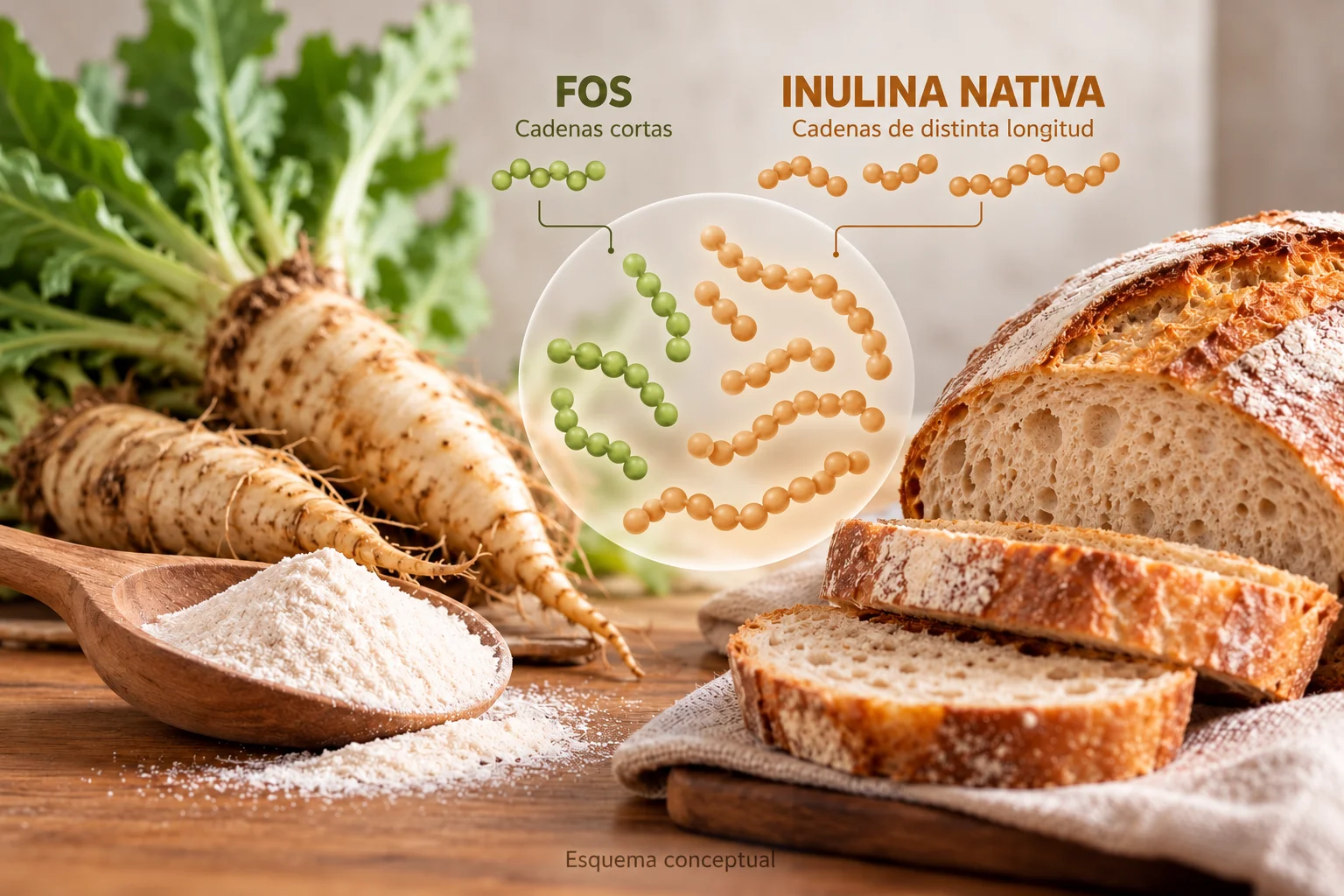
The main difference between inulin and FOS lies in chain length and distribution. FOS are short-chain fructans; native chicory inulin can contain both short and long chains, while other commercial inulins are enriched in longer chains. In bakery applications, choosing a product requires knowing its composition and checking its performance in the recipe. [1] [2] [3]
What are the FOS and what is their relationship with the Inulin?
FOS stands for fructooligosaccharides. They consist mainly of fructose units and may include a terminal glucose unit. These carbohydrates resist digestion in the small intestine and can be fermented by the microbiota in the large intestine. [2] [3]
Oligofructose obtained by partial hydrolysis of inulin belongs to this group. Short-chain FOS can also be obtained by enzymatic conversion of sucrose. The name FOS alone therefore does not indicate that an ingredient comes from chicory. [2] [3]
Chicory inulin belongs to the same fructan family, but commercial products can have different profiles. Native inulin retains a distribution of chain lengths; long-chain products concentrate the longer fractions. The trade name and technical data sheet identify what is being used. [1] [4]
Chain length is described by degree of polymerisation, or DP, which expresses the number of units in the chain. An average DP does not describe the full distribution: two ingredients with similar averages can contain different proportions of short and long chains.
Differences that help you choose the ingredient
The following comparison summarises general trends. Solubility, sweetness and dough performance also depend on the specific ingredient, concentration and conditions of use. [1] [2] [3]
| Aspect | FOS and oligofructose | native inulin | long chain inulin |
|---|---|---|---|
| Chain profile | The short ones predominate. | Distribution of short and long chains. | Enriched in long chains. |
| Solubility | Generally elevated. | It depends on your distribution and presentation. | Generally less than short fractions. |
| Sweetness | Can provide mild sweetness. | Variable according to profile and sugars present. | Usually low in sweetness. |
| What to study in the recipe | Fibre, solubility and partial substitution of sugar. | Enrichment in fibre and balance of properties. | Texture, body and partial fat replacement in suitable matrices. |
Intestinal fermentation and fermentation of the dough
In an in vitro study using human faecal microbiota, FOS samples fermented faster initially than longer-chain inulin samples. The latter showed more sustained fermentation in subsequent hours. This experimental result does not automatically establish better tolerance or greater benefit for a particular ingredient in every person. [5]
Bread fermentation is a separate process. It involves yeasts and, when sourdough is used, its microbiota. The amount of fructans remaining in bread can change during production; it should not be inferred from the rate of intestinal fermentation. [4] [6]
What bakers should check when changing fibres
Evidence from wheat bread shows that degree of polymerisation and fermentation type influence the result. One study compared short-chain, native and long-chain inulin with yeast fermentation and mixed fermentation based on sourdough. It found differences in fructan retention and bread performance. The results apply to the tested formulations, not a universal dosage. [4]
Based on these variables, we propose the following development checks:
Identify the reference and the actual amount of fibre
Note the percentage of fibre declared, humidity, presentation and chain profile available. Compare the ingredients on an equivalent basis: replacing a powder with a syrup at the same weight also modifies the water and solids of the recipe. The grams of incorporated ingredient do not necessarily amount to grams of fibre.
Adjust water by comparable tests
Use a reference recipe and record consistency, stickiness and ease of formation. If you change the ingredient, adjust the water in separate trials and retain the rest of the process to interpret the result. Don't assume that all inulins need the same hydration.
Compare Volume and Texture
Weigh the pieces, use the same tin or shaping method, and compare volume and crumb after equivalent cooling. Also assess slicing and firmness during storage. In cakes, a study using two inulins found differences in height and dryness when replacing part of the sugar: the type of inulin also matters in cakes and pastries. [7]
Register the fermentation and verify the final product
Record the yeast or sourdough, times and temperatures. In gluten-free breads, yeast activity and the specific inulin used have been found to influence fructan losses during production. This supports checking final composition when relevant to the product proposition, without applying an experimental loss percentage to every recipe. [6]
The fibre check should refer to the finished food and the message that is to be communicated. Adding inulin does not allow the final content or compliance with a nutrition claim to be deduced on its own.
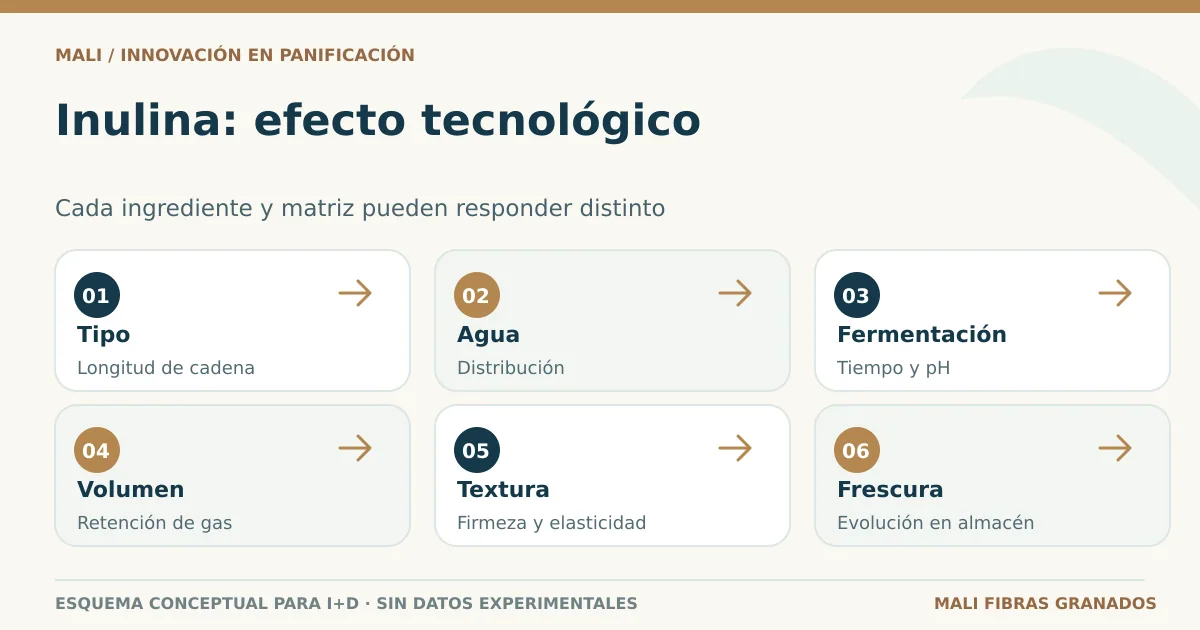
For process adjustments in more detail, see our guide to inulin in bakery and its effects on dough, volume and texture.
The chicory root fibre we use in Mali Fibras Granados
In Mali Fibras Granados we work with chicory root inulin that gathers chains of different lengths. This profile allows us to propose bakery developments with an ingredient that incorporates short and long fractions.
When we seek to gather these fractions into the same raw material, we consider that it offers a more interesting technical profile than that of an ingredient composed exclusively of very short or very long chains.
When inulin contains a range of chain lengths, the formulator works with a more technologically complete raw material.
Here, "more complete" refers to the diversity of present chains. It is the criterion of choice that we propose for these developments; the result of each bread depends on the recipe and the process, and it must be checked by trial.
If your objective is bread with chicory root fibre, explore Prebiomix, an inulin-containing bakery mix, or the guide to defining a bakery product with inulin. Share your bread format, flour and fibre target so we can assess the application.
Frequently Asked Questions
Are inulin and FOS the same?
They are related, but the terms are not interchangeable for any ingredient. FOS are short chain fructans; native inulin gathers a wider distribution and there are long chain specific references.
Does all chicory fibre contain short and long chains?
Origin alone does not define chain-length distribution. Native inulin, long-chain inulin and oligofructose are all marketed from chicory. The specific ingredient must be checked. [1] [2]
Can FOS and inulin be replaced with the same weight?
Technological equivalence should not be assumed. It is best to compare fibre, solids, water and sweetness, and repeat the tests of consistency, volume and texture.
Does inulin always improve softness?
No. Results depend on the formulation, ingredient and process. Studies in bread, cakes and pastries show different responses, so the specific application must be validated. [4] [7]
Sources and references
- COSUCRA. FIBRULINE and FIBRULOSE range. Manufacturer's documentation of types, properties and applications. Back to text: 1234
- BENEO. Oligofructose. Origin by hydrolysis of inulin, solubility and sweetness according to reference. Back to text: 12345
- BENEO. Short Chain FOS. Obtaining from sucrose and ingredient characteristics. Back to text: 1234
- Mohammadi et al. (2021). Inulin enriched wheat bread: interaction of polymerization degree and fermentation type. Journal of Food Measurement and Characterization, 15, 5408–5417. Experimental study in wheat bread. Back to text: 1234
- Stewart, Timm and Slavin (2008). Fructooligosaccharides exhibit more rapid fermentation than long-chain inulin in an in vitro fermentation system. Nutrition Research, 28, 329–334. In vitro study. Back to text: 1
- Morreale, Benavent-Gil and Rosell (2019). Inulin enrichment of gluten free breads: Interaction between inulin and yeast. Food Chemistry, 278, 545–551. Experimental study in gluten-free bread. Back to text: 12
- The Functionality of Inulin as a Sugar Replacer in Cakes and Biscuits; Highlighting the Influence of Differences in Degree of Polymerisation on the Properties of Cake Batter and Product (2021). Foods, 10, 951. Experimental study in cakes and pastries. Back to text: 12