Protein and Bakery
High-protein cakes and muffins: development at industrial scale
Guide to converting a protein target into cakes and muffins with a careful consumption experience, a viable process and validated communication.
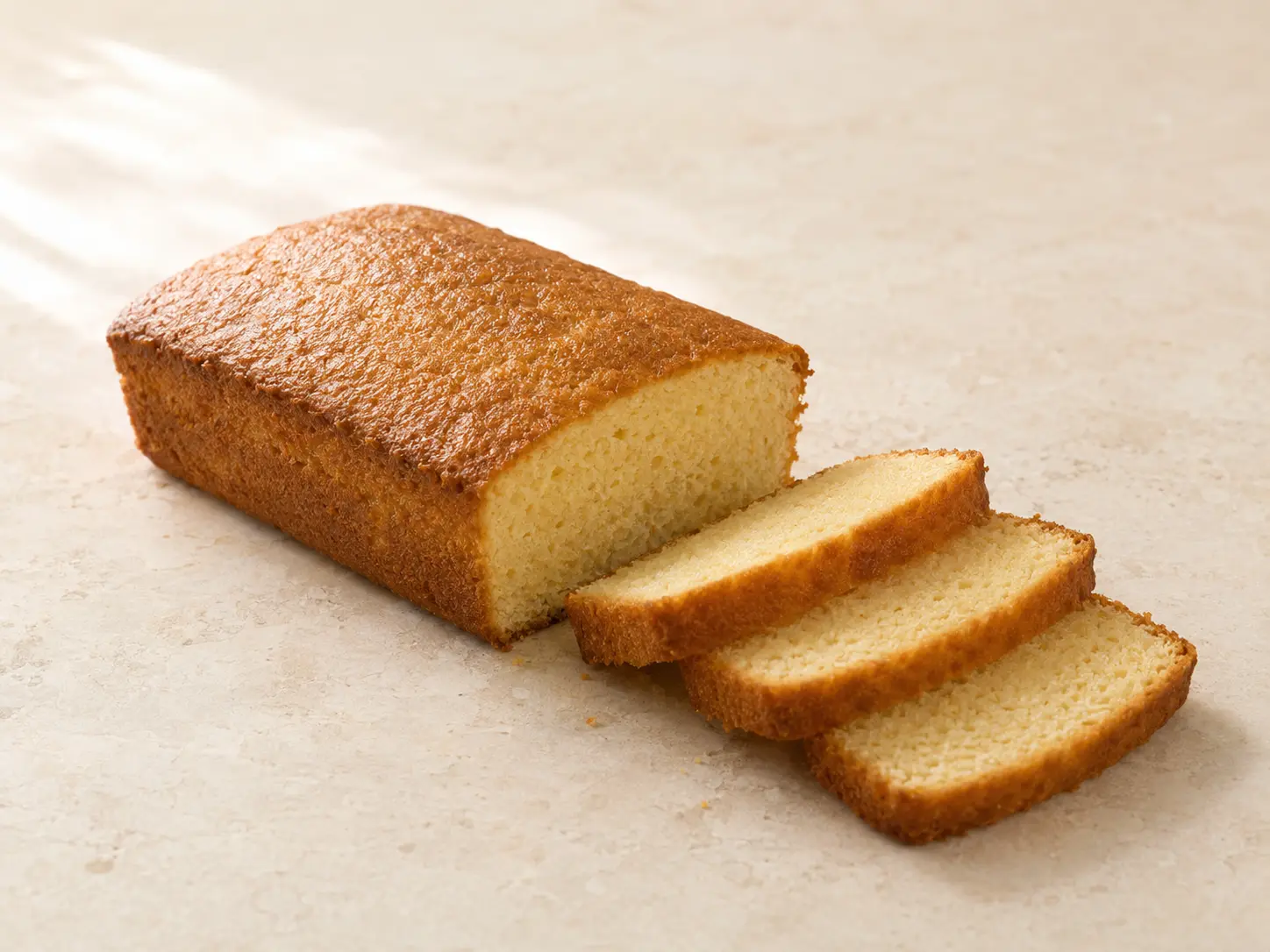
Developing cakes and pastries high in protein requires working two results at the same time: the nutritional profile and the consumption experience. A cake or muffin must reach the protein target without losing sight of volume, texture, taste, uniformity and functioning in production.
Adding protein can change batter performance and the structure of the baked product. Research across different cake and pastry matrices shows that the response depends on the protein source, its combination with other ingredients and the process. There is no universal flour-to-protein substitution that produces the same result in every recipe. [3] [4] [5]
For an industrial bakery or a chain with central bakery, development begins by defining the product and ends up validating it under the actual conditions of manufacture and marketing.
When a ‘high protein’ cake can be declared
In the European Union, the “high protein” claim requires protein to provide at least 20% of the food’s energy value. For “source of protein”, the threshold is 12%. These are not percentages by weight or a fixed number of grams per 100 g. [1]
To check the energy ratio using kilocalories:
Energy percentage of protein = (protein grams × 4 / kilocalories total) × 100.
Protein and energy values must refer to the same quantity of food. The factor of 4 kcal per gram comes from the Food Information Regulation. Total energy must be calculated using the appropriate factors for every component of the recipe. [2]
Example: the same grams do not involve the same result
| Illustrative example, per 100 g | Protein | Total energy | Protein energy | Result from the 20 % threshold |
|---|---|---|---|---|
| Product A | 15 g | 300 kcal | 20,0 % | It reaches the threshold mathematically. |
| Product B | 15 g | 360 kcal | 16,7 % | It doesn't reach the threshold. |
These examples explain the calculation: they are not nutritional values for a Mali Fibras Granados product, nor do they validate a label. Development must allow for actual variability rather than rely on rounding to meet the objective.
For the cake or muffin in this guide, the calculation applies to the finished food: it includes ingredients added by the manufacturer and any fillings or toppings. Knowing the dry mix composition is not enough. Values can be substantiated using methods permitted by the regulations, including analysis and calculations based on reliable data; a claim does not, by itself, always require a laboratory test for every batch. [1] [2]
Define the product before reformulating
We propose to agree on a brief starting document between R&D, Marketing, Quality and procurement:
| Decision | Question to be resolved |
|---|---|
| Format | Cake for slicing, individual portion or muffin? |
| Experience | What volume, texture, taste and appearance are we looking for? |
| Nutritional objective | What composition and declaration are they trying to communicate? |
| Production | Which equipment, depositing system, tins and production rate will be used? |
| Marketing | In what packaging, channel and conditions will it be sold? |
| Project conditions | What ingredients, allergens, costs or specifications limit development? |
A clear goal avoids correcting the recipe in incompatible directions. For example, if you change both protein, sugar, fat, piece size and packaging system, it will be more difficult to interpret what explains a difference in texture.
A cake batter doesn't work like a bread dough.
In cakes and pastries, batter performance, air incorporation and retention, and structure formation during baking shape the product. The gluten-development approach used for bread dough should not simply be transferred to a cake. [3] [4]
Proteins are not technologically equivalent. Research has found differences in batter density and viscosity, as well as product volume and firmness, when protein sources or combinations change. Some studies use gluten-free formulations, so their results help identify variables rather than predict a different industrial recipe. [3] [5]
The practical conclusion is not that one protein is always better than another. It is that selection must be assessed within the complete system, using the project’s actual specifications.
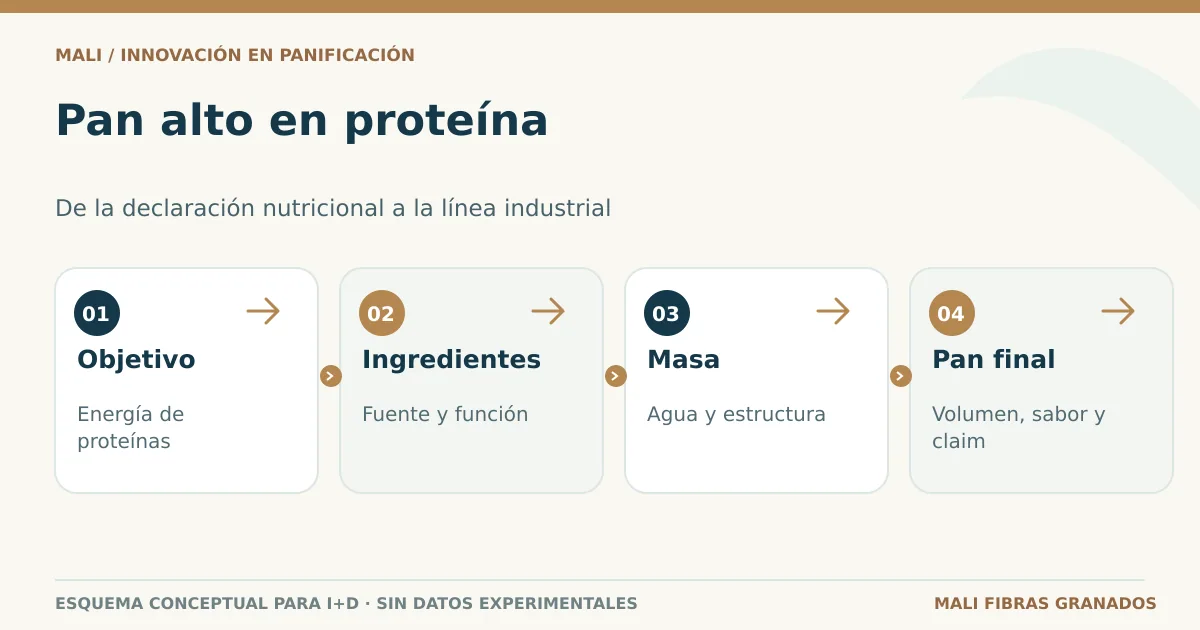
Development plan
From objective to documented decision
- ObjectiveNutrition, consumer experience and industrial process
- PrototypeA reference and changes identified
- EvaluationComposition, texture, volume and preservation
- DecisionAdopt, adjust or repeat according to agreed criteria
Work proposal for R&D, Quality and Production. It does not represent a trial or results of a Mali Fibras Granados product.
Texture, volume and taste: what should be evaluated
Volume and structure
We propose to record the volume and uniformity between pieces, in addition to observing the crumb. A higher muffin is not necessarily better if it has sinking or large cavities that do not fit the desired product.
Faced with a deviation, it is worth comparing the batter, the mixing method, the waiting before deposition and the behaviour in the oven. They are research variables, not an automatic diagnosis or a recommendation to always increase the intensity of mixing.
moistness and firmness
Perceived dryness should not be attributed solely to the amount of added water. Studies of protein cakes have found simultaneous changes in volume, structure, texture and sensory perception. [4]
Define what the team means by “moistness” and assess it using a consistent procedure: serving temperature, time since production, sample size and evaluation criteria. Moisture measurement can be useful but does not replace texture assessment.
Taste, aroma and colour
Protein composition can also influence sensory characteristics. A study of cakes with whey protein observed changes in colour and texture; this does not demonstrate that a plant-based blend or a Mali Fibras Granados product will behave in the same way. [4]
Instead of correcting by intuition, we propose contrasting the expected profile with coded samples and recording what difference is acceptable for the product.
Diagnostic table for the first prototype
The following are working hypotheses, not confirmed causes. The aim is to organise trials without changing several factors indiscriminately.
| Observation | What we propose to investigate | What to Compare |
|---|---|---|
| Crumb too compact | Batter performance, incorporated air, ingredients and structure after baking. | Volume, crumb cell distribution and firmness. |
| Dry sensation | Ingredients matrix, production and evolution from baking. | Sensory assessment and agreed physical measurements. |
| Sinking or uneven volume | Batter stability, depositing and structure setting. | Differences between parts and production moments. |
| Taste or colour away from the target | Raw materials and production conditions. | Sensory reference defined for the range. |
| Results vary between batches | Specifications, process records and variations of raw material. | Results of representative lots, not a single piece. |
| Protein target not achieved | Complete calculation, added ingredients and final composition. | Protein and energy on the same food base. |
When several scenarios are plausible, it is preferable to design a comparison that makes it possible to distinguish between them. Recording changes is better than accumulating prototypes without traceability.
From the test to the central bakery or industrial line
A proposal that works in a small trial still needs to be checked in production. We organise that transition into three steps:
Set a reference. Register what is considered an acceptable result: size, weight, volume, texture, taste and composition.
Check the actual process. Evaluate performance with available equipment, waiting times and uniform deposition. Document deviations and final result.
Agree release criteria. Define with Quality the necessary documentation and checks. Purchases must have the specifications that condition repeatability and information to assess the cost of use.
We do not publish standard mixing or baking parameters because they must be set for each development. Nor do we assume that the same adjustment works for every size and format.
Evaluate conservation, not just on production day
Initial acceptance does not demonstrate performance throughout the product’s commercial life. The plan must consider how the product changes in its packaging under the expected conditions, alongside relevant safety criteria. [6]
The shelf-life guide explains the general evaluation framework. For cakes and muffins, it must be adapted to their own food matrix and any fillings or toppings; the shelf life of bread or another pastry product cannot simply be adopted.
A protein mix does not in itself demonstrate a certain shelf life. Validation corresponds to the finished food.
Protein Repostería: a Mali Fibras Granados solution for this development
Protein Repostería, a mix for protein cakes and pastries, is the Mali Fibras Granados blend for projects seeking to combine protein content with moistness, volume and flavour. Its product information covers cakes, muffins and other formats. [7]
As an application reference, the public product information states 17 g of protein per 100 g of cake. This is an indicative value for the recommended recipe and must be checked against the final formulation and process. It does not replace the energy-value assessment needed to approve the claim for the finished product. [1] [7]
Technical information about the mix and its application is provided directly to the manufacturer. If the project requires another combination of ingredients, format or production conditions, a bespoke development can be assessed.
Do you want to develop a high-protein cake or muffin?
Tell us the format, nutritional objective and manufacturing conditions. We will assess how Protein Repostería fits your project.
Sources and references
- Regulation (EC) 1924/2006, Annex to nutrition claims — Energy thresholds of “source of protein” and “high protein”. Back to text: 123
- Regulation (EU) 1169/2011, Article 31 and Annex XIV — EUR-Lex file with access to the consolidated version: calculation bases and energy conversion factors. Official publication in Spanish at the BOE. Back to text: 12
- Bravo-Núñez and collaborators. Optimisation of protein-enriched gluten-free layer cakes using a mixture design (2020) — Interactions between protein sources in gluten-free batters and cakes. This is not a trial of Protein Repostería. Back to text: 123
- Maravić et al. Effect of Sourdough and Whey Protein Addition on the Technological and Nutritive Characteristics of Sponge Cake (2022) — Study of a specific formulation; not extrapolable as a guarantee to other recipes. Back to text: 1234
- Quality protein maize based muffins: influence of non-gluten proteins on batter and muffin characteristics (2019) — Technological differences between protein sources in a specific matrix of gluten-free muffin. Back to text: 12
- FSAI. Guidance Note 18: Validation of Product Shelf-life (2022) — General safety and quality validation framework. Back to text: 1
- Mali Fibras Granados. Protein Repostería public product information — Commercial source of the guidance data and the applications mentioned; it is not presented as independent scientific evidence. Back to text: 12