Product trends and development
Clean-label bakery: rethinking your formulation for 2027
Simplify a bakery formulation while preserving texture, process performance and shelf life. Custom-development criteria for R&D, procurement and quality.
Clean label describes commercial expectations about ingredients and formulations perceived as simple. It does not function as a general authorization or show that a product is safer or healthier. For R&D, a useful project starts by defining exactly what you want to change and what features should be maintained.
Translate an ambiguous request to a specification
‘We want a cleaner label’ does not allow for formulation. It is necessary to specify ingredients that you want to review, commercial motive, market, cost and sensory objective. A shorter list may still be difficult to understand; a longer list may accurately describe a mixture of cereals and seeds.
Quality should review each proposed expression. Food information cannot be misleading and nutritional or health claims have their own rules. Do not presume that ‘natural’, ‘without’ or ‘fermented’ justify any message.
Removing an ingredient requires understanding its function
| Changing function | What to compare to the current product |
|---|---|
| Structure | Volume, Form and Stability |
| Water retention | Crumb and texture evolution |
| Storage | Validated safety and shelf life |
| Taste and colour | Acceptance and regularity between lots |
Removing a component can shift work to the process or packaging. The economic comparison should therefore include waste, time and checks, not just the replacement ingredient’s cost.
A reformulation trial to allow decision-making
Retain a control product and record changes. Compare the product freshly made and during storage. If the preservation system changes, do not carry over the previous shelf life without validation.
Procurement should request an up-to-date technical data sheet, allergen information, ingredient identification, availability and notification of changes. The supplier review guide for 2027 helps structure this part of the project.
Criteria for R&D
Reform with a reference
- IdentifyWhat role does the ingredient play?
- CompareWhat the product should keep
- ValidateProcess, acceptance and shelf life
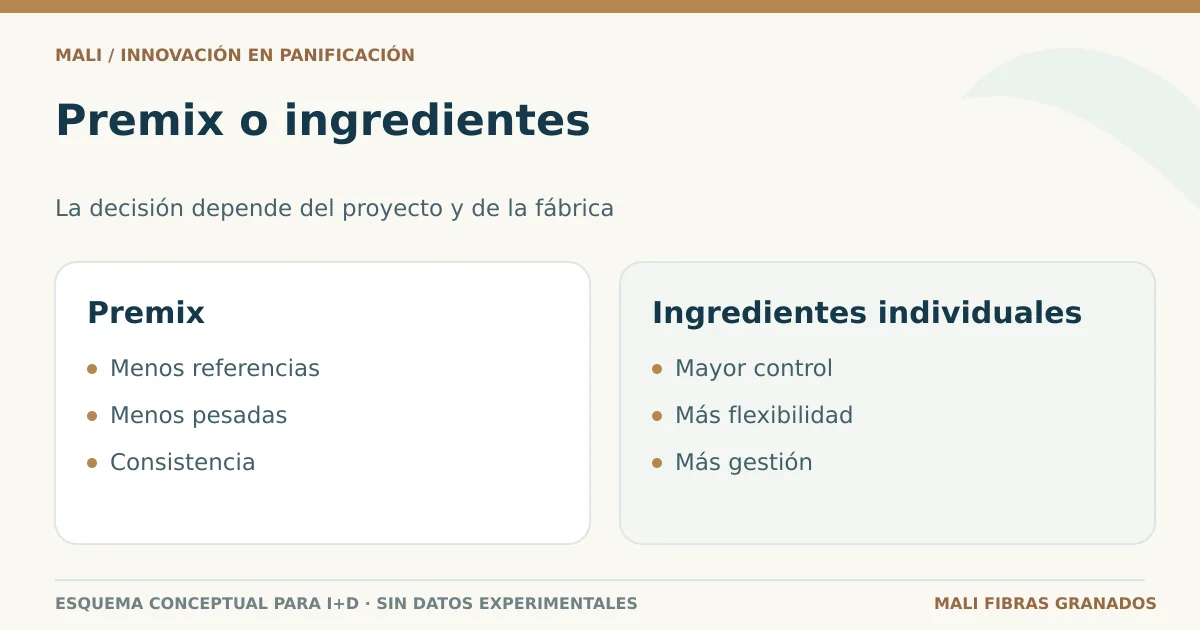
Decision scheme; does not represent experimental results of a Mali Fibras Granados formulation.
Known ingredients, results to be checked
Wholegrain ingredients, pulses, seeds or fermented ingredients may fit the positioning. Their presence does not guarantee lower complexity or better nutrition. See what to assess in bioprocessed ingredients before attributing functions to them.
Functional replacement sheet
Document what you intend to keep before changing an ingredient. If its function is not defined, it will be difficult to distinguish an improvement from a loss of performance.
| Before the change | After the change |
|---|---|
| Function of the ingredient | Alternative and mechanism to be checked |
| Volume and texture reference | Result against the same control product |
| Storage and packaging system | Validation of shelf life required |
| Cost per saleable product | Raw materials, waste and processing time |
Final approval should include ingredients, allergens and communication, in addition to the industrial outcome. This tab organizes the reformulation; it does not certify a clean label positioning alone.
Clean label does not automatically mean removing every additive or producing an allergen-free product. Define the intended change and verify its function, labelling information and results. If it affects storage stability, use the shelf-life evaluation guide.
Custom-made development with Mali Fibras Granados
A specific brief might be “revise this ingredient list while maintaining protein, texture and production-line performance”. Mali Fibras Granados can assess the bakery application and feasibility of a new mix. Standard mixes should not be assumed to meet a particular definition of clean label. Propose the formulation you want to reconsider.