Product trends and development
How to choose a functional bakery mix supplier
An approval guide for Purchases, Quality and R&D: specifications, traceability, allergens, repeatability, support, supply and total cost of use.

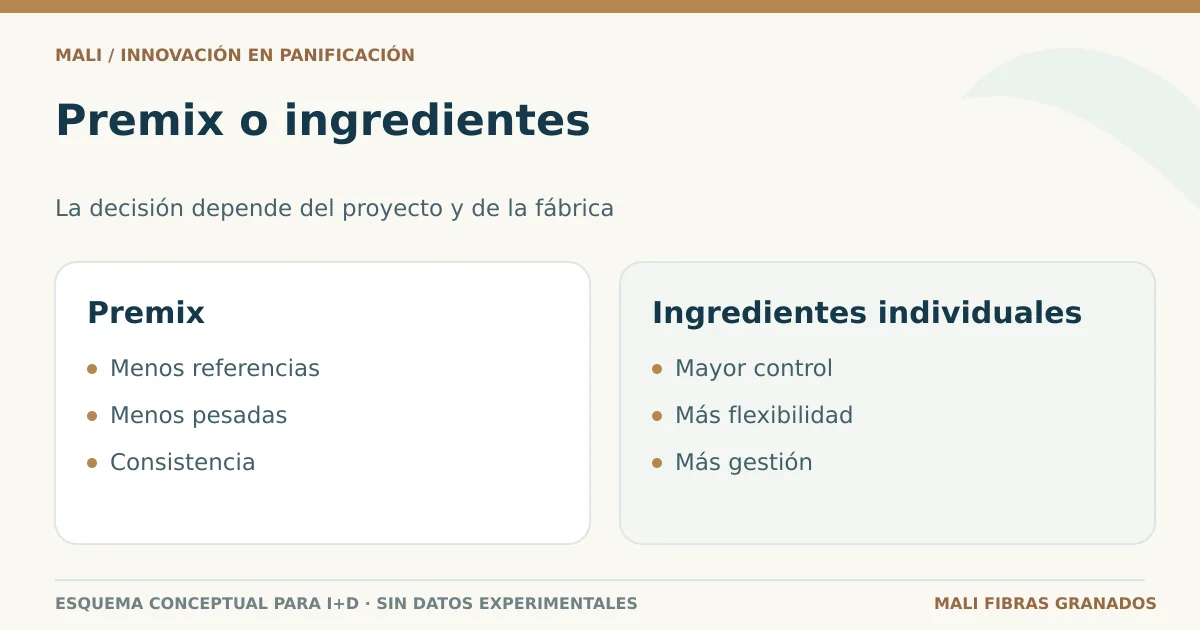
Procurement cannot assess a functional mix solely on price and lead time: if it affects composition, nutrition claims or production-line performance, documentation, traceability, consistency and support must also be approved. This guide outlines the questions to ask a potential supplier. To decide whether a mix is needed, see premixes versus individual ingredients.
In summary
- First define the product specification and its function in the recipe.
- Check traceability, allergens and change control with Quality.
- Test batch repeatability and industrial scale application with R&D.
- Assess supply continuity and total cost as well as price per kilo.
- Request evidence of any certification or capability that is decisive for approval.
Specifications: know what you are buying
A useful technical data sheet allows to review declarable composition, physico-chemical parameters, nutritional profile, allergens, conservation and shelf life when appropriate. There should be a procedure for communicating changes in ingredients or conditions of use. IFS Food 8 requires companies evaluated under this standard to have up-to-date and clear specifications of raw materials; citing this criterion does not imply that a particular supplier is IFS certified.
Procurement and Quality must agree which documentation is essential for the finished product and which mix parameters will be checked at each delivery or batch.
Traceability: from supplier to finished product
Article 18 of Regulation (EC) 178/2002 requires traceability at the production, processing and distribution stages and ability to identify supplier and immediate customer. In the type-approval it is appropriate to ask how each batch is identified and how it is linked to its raw materials, manufacture and deliveries. A withdrawal or simulation test may reveal whether the information is recovered in time.
Supplier Approval
Three teams, same decision
- PurchasesTotal price · continuity · deadlines
- QualitySheet · allergens · traceability
- I+DFunction · consistency · scale-up
The list prepares the evaluation of the supplier; it does not replace an audit.
Allergens and Formulation Changes
Wheat and soya are among the allergens listed in Annex II to Regulation (EU) 1169/2011, as is lupin. Do not infer a mix’s allergen profile from its trade name. Request the allergen list, information about possible cross-contact, assessment criteria and the procedure for advance notification of changes. Quality must assess the impact on the label of the food the factory will sell.
Batch consistency and production-line performance
A variation in particle size, protein, or absorption capacity can change kneading, fermentation, volume, and texture. Compare lots in the same formulation and record critical process variables. A mix must conform to the limits defined for the final product, not be limited to looking visually homogeneous.
R&D support and regulation
Ask whether the supplier has application data, can support trials and understands adaptation to industrial equipment. If a “high fibre”, “high protein” or health-benefit claim is intended, check the conditions of use against the finished product. Supplier documentation helps, but the business marketing the food must verify its composition and communication.
Supply and capacity for adaptation
Assess lead times, capacity, the origin of critical raw materials and contingency plans. Do not assume every supplier can customise a mix: ask about scope, timing, minimum quantities and change control. Continuity is verified through contracts and operations, not a slogan.

Price per kilo versus cost of use
A useful comparison includes price, quantity required per batch, handling, storage, waste, development time, checks and potential stoppages or errors. The cheapest mix per kilo may prove expensive in the factory, while a higher-priced mix may simplify operations. To understand the choice between a mix and individual raw materials, see this comparison of premixes.
Checklist for Purchases
| Area | Question for approval |
|---|---|
| Quality | Is there a current specification and change control? |
| Traceability | Do you identify ingredients, lots and deliveries? |
| Allergens | Are mandatory allergen declarations and cross-contact risks documented? |
| R&D | Is application evidence available for the food matrix? |
| Claims | What information makes it possible to verify the final food? |
| Production | Is performance consistent between batches? |
| Supply | Are deadlines and response to incidents agreed? |
| Cost | What is the total cost on the line and product? |
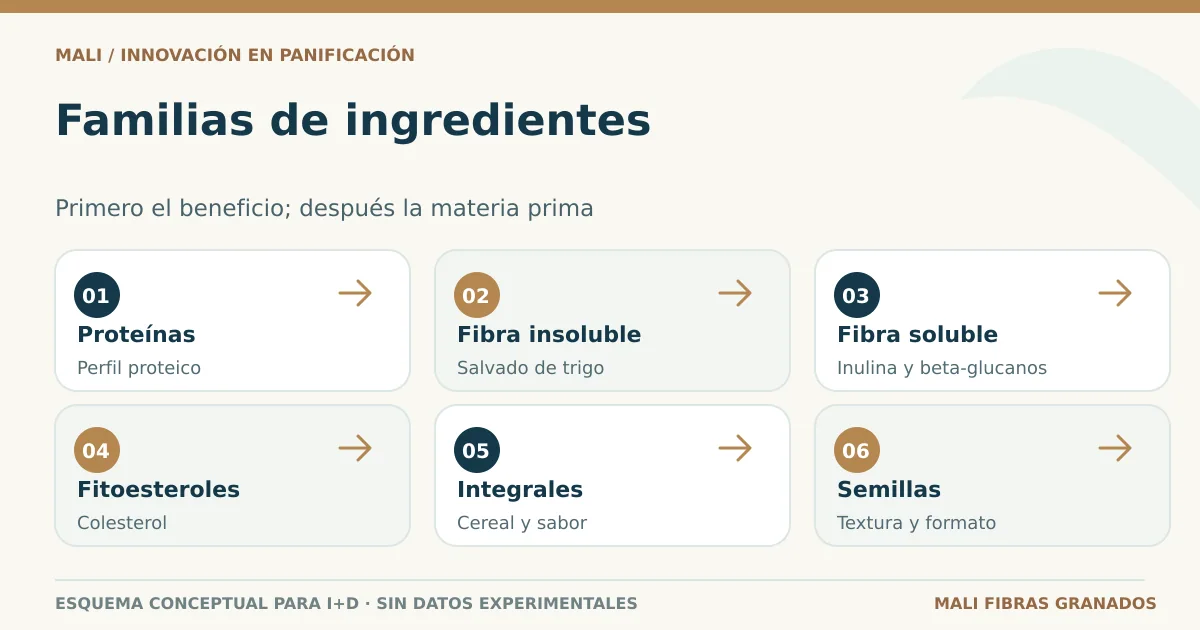
Mali Fibras Granados develops mixes for prebiotic fibre, intestinal transit, phytosterols, high-protein bread and protein snacks. When assessing a project, first compare the functional ingredient areas and request the documentation and trials your Procurement, Quality and R&D teams need.
To assess how our range fits your needs, browse the mixes for professional bakeries by application and objective, and specify the documentation your project requires.
Initial approval matrix
Separate mandatory requirements for trade preferences. A good price score does not compensate for an incomplete specification or an unsolved safety requirement.
| Area | Evidence to be requested | Evaluation outcome |
|---|---|---|
| Identity and specification | Current data sheet and conditions of use | Compliant, pending or non-compliant |
| Safety and allergens | Applicable information and controls | Quality Approval |
| Traceability | Batch identification and procedure | Traceability capability |
| Application | Sample and test in product | R&D and Production acceptance |
| Supply | Time limits, minimums and communication of changes | Purchasing feasibility |
These are evaluation criteria, not a statement of specific Mali Fibras Granados certifications. Once the supplier has been approved, see the supply continuity and reformulation review.
After approval: prepare changes and alternatives
The supplier review for the 2027 procurement plan covers supply continuity, change control and substitution trials.