Product trends and development
bakery innovation ingredients for 2027: what should R&D prioritise?
A selection of ingredient families and a decision matrix for R&D and Purchasing to turn market signals into industrial testing by 2027.
To prepare the 2027 innovation, an industrial bakery needs to select ingredients that solve a briefing: what they contribute to food, how they work on the line, and what cost and documentation they require. This guide proposes trial priorities; it does not present as future facts market shares or ingredients that have not yet proved fit in the product.
The bakery analysis published by Innova in March 2026 highlights protein, bowel health and convenience formats. Based on these signals, Mali Fibras Granados proposes the following areas of work for R&D and Procurement. These are development hypotheses to validate with the channel and target consumer.
In short: three decisions before asking for samples
- Define a product need and measurable success criteria.
- Separate well-known application ingredients from alternatives that require further research.
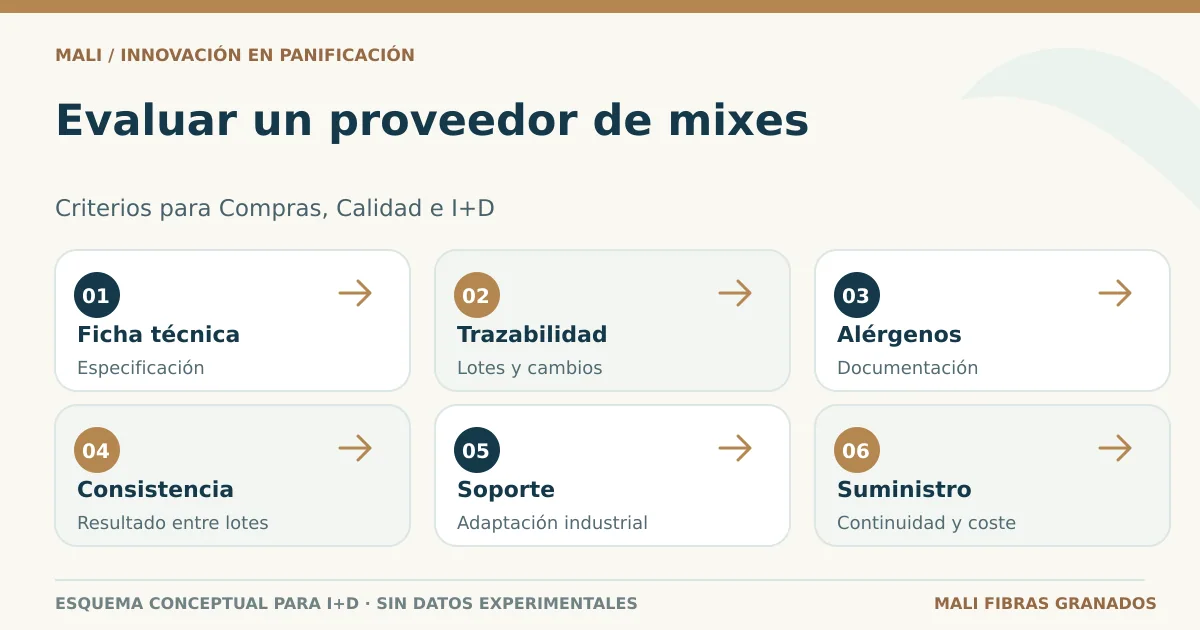
- Compare cost per finished product, consistency, documentation and continuity of supply.
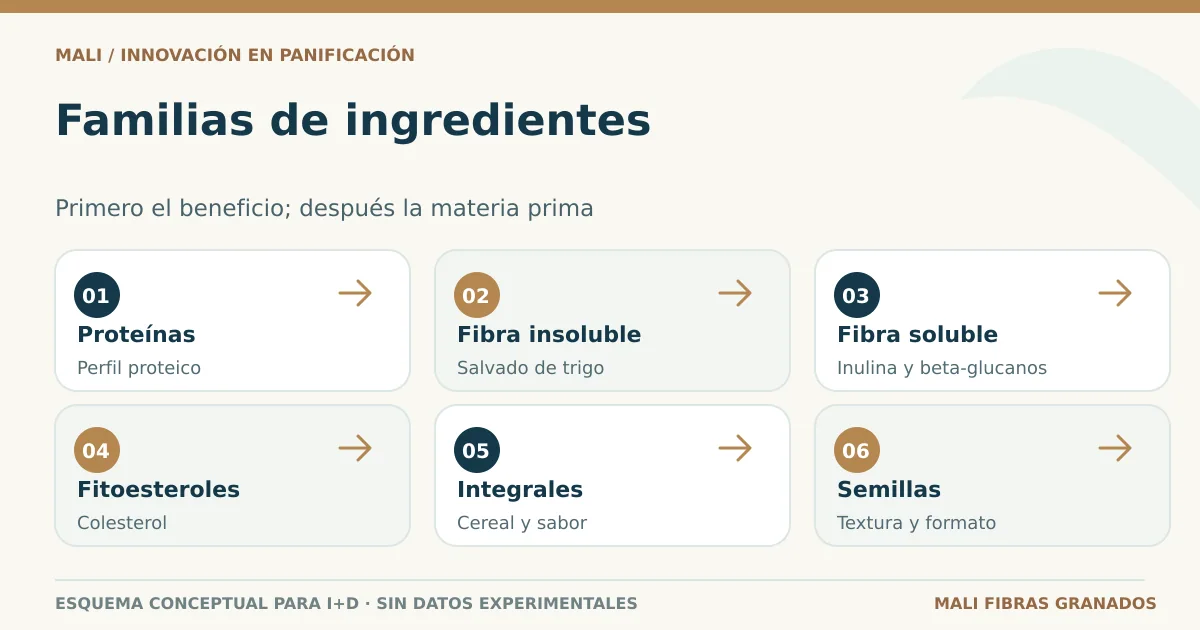
Plant protein: choose a function before a provenance
Soya, wheat, pea, chickpea, faba bean and rice can all be assessed. Their value depends on the specific specification: flour, concentrate and isolate from the same plant do not necessarily perform in the same way.
The first trial should establish whether the raw material can meet the nutritional objective while preserving flavour, volume and process tolerance. The comparison of plant proteins in bakery explores technical selection. Protein Pan and Protein Snacks are solutions for protein applications; a different combination can be assessed as a bespoke development, without assuming it is part of their current composition.
Prebiotic fibres: nutritional interest and validation in bread
Chicory inulin is relevant to prebiotic fibre and the gut microbiota. Prebiomix contains prebiotic fibre from chicory inulin. Production performance and final content should be included in the trial, alongside a review of the claims permitted in the target market.
An ingredient’s prebiotic status does not authorise any health promise. See the guide to inulin and prebiotic fibre to distinguish the ingredient, evidence and communication.
From Interest to Trial
Three filters before incorporating a raw material
- NeedAn application and a difference that the customer values
- FeasibilityProcess, documentation, supply and cost of use
- ValidationPrototype, acceptance and industrial testing
The selection for 2027 is a working hypothesis, not a sales forecast.
Mixtures of fibres, whole grains, vegetables and seeds
One opportunity is to improve formulation using familiar ingredients. Fibra Verde combines soluble and insoluble fibres, wholemeal flours, different brans, dehydrated vegetables and seeds. Its value for the manufacturer lies in the combined nutritional, technological and sensory result.
Fibra Verde enables the development of high-fibre breads that support intestinal transit, using a combination of fibres and plant ingredients. The article on Fibra Verde and bowel-health benefits explains the specific validation required. A different fibre does not automatically replace the fibre underpinning that claim.
Beta-glucans, resistant starch and arabinoxylanes: research specification
They are families that are worth assessing when they respond to a specific objective. The origin, processing, composition and function vary between ingredients. Before incorporating them into the plan, ask for information that allows us to decide what should be measured in the prototype and final food.
Mali Fibras Granados does not present a specific catalogue mix for every one of these ingredient families here. If they fit the brief, the next step is to assess feasibility through bespoke development. The general guide to functional ingredients helps compare these areas without confusing this selection for 2027 with a list of guaranteed new products.
Pulses and co-products: two different procurement questions
For pulse flour, characterise protein, fibre, flavour and application. For an ingredient obtained from spent grain, pomace or another side stream, food suitability, traceability and variability must also be documented. Using a co-product does not, by itself, demonstrate lower environmental impact: that comparison requires process and product data.
The European Commission explains how novel food status is assessed. The catalogue is indicative; evaluation depends on the ingredient and its production process. The Quality team must verify status and conditions of use before launch.
phytosterols: a specific project from the beginning
Fibracol offers a route to cholesterol-reduction products within the applicable conditions. This is not a matter of adding phytosterols to any bakery product: the authorised category, composition, portion size and labelling shape development. The guide to developing a product with phytosterols details that route.
A matrix to decide what enters the 2027 plan
| Decision | Evidence to ask for | Next step |
|---|---|---|
| Provides a relevant difference | Briefing and customer need | Choose an application |
| It works in the process | Specification and dough test | comparative trial |
| Can be communicated | Category review and claims | Quality Validation |
| Reliable supply is available | Time limits, lots and alternatives | Approval |
| It makes economic sense. | Cost per saleable unit | Compare scenarios |
| Worth scaling up | sensory, repeatability and shelf life | Industrial test |
From selected ingredient to development with Mali Fibras Granados
Prioritise a small number of hypotheses with clear questions. Examples include a protein product with improved texture, a high-fibre bread with a defined benefit or a new savoury format. To organise procurement, use the criteria for choosing a bakery mix supplier.
You can start with a catalogue mix or propose a new application. Tell us which ingredient, format and objective you are considering for 2027.
Prioritize Trial Portfolio
A raw material deserves a test when it fits a project and there is a question that the trial can solve. The notoriety of the ingredient does not replace the evidence or the supply.
| Filter | To advance if... | Wait if... |
|---|---|---|
| Application | There is a defined product and function | There is only generic interest |
| Evidence and regulation | Use and message can be reviewed | Lack of identity or conditions of use |
| Supply | There is representative sample and specification | The sample does not reflect industrial supply |
| Effort | The test solves a specific uncertainty | Everything needs to change, with no success criteria |
This prioritisation is a proposed working approach from Mali Fibras Granados. To compare the functions of each family, return to the functional ingredient map.
Explore the raw materials in more detail
To define the trial plan, see functional fibres, cereals and pseudocereals and evaluating food co-products. The ingredients and formulation section brings together these selection and implementation decisions.